Showing posts with label writing. Show all posts

Thursday, September 15, 2011

Don't you have to write it to own it?

In a seeming triumph of culture over commerce... of high art over pop art... of the little guy over the big, bad mogul... author Chinua Achebe has succeeded in forcing rapper 50 Cent to change the title of his upcoming movie.

As reported last week in the culture blog, Vulture (and HuffPo and EW, etc.) the facts lay out as follows:

In 1958, Achebe wrote what is widely acknowledged as the most read African novel of all time, titled "Things Fall Apart."

In 2010, 50 Cent wrote, produced and financed a film directed by Mario Van Peebles, about a football player diagnosed with cancer, also titled "Things Fall Apart."

In 2011, Achebe's lawyers contacted 50 Cent to rename his movie prior to its release. In response, 50 Cent offered Achebe $1 million to be allowed to use the title. Mr. Achebe's legal team refused 50 Cent's offer, saying "the novel with the said title was initially produced in 1958 (that is 17 years before [50] was born). [It is] listed as the most-read book in modern African literature, and won't be sold for even £1bn."

This is the point at which 50 Cent agreed to rename his movie “All Things Fall Apart.”

Were I 50 Cent, rather than acquiesce, I might instead have replied to Achebe's representatives, "tread softly, because you tread on my dreams," and then gently reminded them that Chinua Achebe took his title from a William Butler Yeats poem, "The Second Coming":

Turning and turning in the widening gyre
The falcon cannot hear the falconer;
Things fall apart; the centre cannot hold;
Mere anarchy is loosed upon the world...

I might have gone on to note that 50-some years ago, when Mr. Achebe's novel was about to be released, Yeats' legal team evidently declined to ask Mr. Achebe to re-title it, nor did they point out that "the poem with the said phrase was initially published in 1920 (that is 10 years before [Achebe] was born). It was written by one of the most venerable poets of the 20th century, and won't be sold for even £1tn."


"The worst are full of passionate intensity." Indeed.

(This post is dedicated to my big sister, who introduced me to Yeats, and to Achebe and Didion, and to a whole assortment of great authors — and who can recite this poem from memory.)

Saturday, July 03, 2010

The Declaration of Independence in 140 Characters or less

Could you declare independence and start a revolution in 20 words or less? Slate Magazine ran a contest for best tweet to do just that. They put it this way, "rewrite the Declaration of Independence in a single tweet."

Straight from the magazine's mouth, here are the results:

declarationind.jpgThe third runner-up, for straddling the delicate balance between the literal and humorous: @Boston1775: "We seek independence based on noble and universal ideas combined with petty and one-sided grievances."

The second runner-up, for his direct and confrontational tweet, goes to @TJMonticello: "All peeps are equal. Sick and tired of your tyrannical BS. Seeking independence. Your permission requested, not required."

The first runner-up, for both historical accuracy and a Twitter-worthy modernization of communication, goes to
@badanes: "Our Rights from Creator (h/t @JLocke). Life, Liberty, PoH FTW! Your transgressions = FAIL. GTFO, @GeorgeIII. -HANCOCK et al."

And finally, our winner—according to his Twitter bio, a former writer for Conan O'Brien and The Daily Show—is @ApocalypseHow, for reminding us that brevity is the soul of wit: "Bye George, we've got it."


By George, I think we did.

Happy July Fourth, everyone!

Friday, May 21, 2010

I think I've heard that song before

Nah, I just saw it on Lifetime.


Coming out this fall is yet another Katherine Heigl rom-com (when does that girl sleep?), "Life as We Know It." In and of itself, that's not really remarkable, and in fact, I only stumbled on it because I was busy researching Greg Berlanti, co-creator on "No Ordinary Family," a show just picked up for the fall season by ABC (see "Couch Potato ABCs").

What I did, however, find remarkable is the movie's uncanny similarity to a TV movie I recently watched (okay, I admit it), literally, on Lifetime. Here's the synopsis for the brand-spanking new, yet-to-be-released "Life as We Know It" floating around:

Holly Berenson (Katherine Heigl) is an up-and-coming caterer and Eric Messer (Josh Duhamel) is a promising network sports director. After a disastrous first date, the only thing they have in common is their dislike for each other and their love for their goddaughter, Sophie. But when they suddenly become all Sophie has in the world, Holly and Messer are forced to put their differences aside. Juggling career ambitions and competing social calendars, they'll have to find some common ground while living under one roof.

And here's the IMDB synopsis for "Raising Waylon" (as broadcast on CBS in 2004 and on Lifetime more recently):

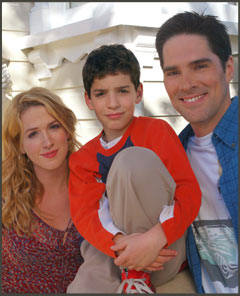
Ten years ago, Julia (Poppy Montgomery), a globe-trotting photographer with a thing for rockstars, and Reg (Thomas Gibson), a blue-collar coffee shop owner with a thing for models, came away from their lone date together with an intense dislike for one another. Nonetheless, their mutual friends (responsible for that one date) named them godparents to their son. When the boy's parents unexpectedly die, they're forced back into each other's lives and under the same roof to take care of him.

Um...?

Monday, March 01, 2010

So right... and then so wrong

It's sad when something that starts so right goes so terribly wrong. Ted Bundy, AOL/Time Warner, the Segue, "Leverage."

I believe it's season 3 of Leverage that just ended — truthfully the second and third seasons blended together in my mind in a mix of bored-out-of-my-skull and "huh?" — I'm not really sure if it's 2, 3 or maybe even 4 that just shuddered to a halt. Which is a real shame, because the first season was great. Really. Like, can't wait for next week's episode good. Like, what will they think of next? good. And then came some major sophomore slump. Screech to a halt, slam on the brakes, make an emergency brake 180, what in blazes happened? slump-eroo.

In the spirit of cloud/silver lining, I'm going to say that Leverage Season 1 v. Leverage Seasons 2 & 3 provides great lessons in what makes for good episodic TV and what doesn't (and some other things thrown in for extra credit). Like all rules, these rules can be broken, if you know what you're doing. Otherwise, rules are rules for a reason. Like cliches.

What's the first rule? Underlying story arcs make better episodic television. Think about the first season of Veronica Mars. Think about any season of Friday Night Lights (talk about a built-in underlying story arc). Think Burn Notice. Think The Mentalist. When there aren't story arcs, there are character arcs. Bones. NCIS. And don't talk to me about Law & Order because it's a law unto itself. I did say that rules can be broken.

Are we all on the same page? To sum up: Leverage is about a motley crew (ha!) of thief, grifter, muscle, hacker and ex-insurance investigator/mastermind (Thomas Crown Affair, anyone?) that bands together for a little revenge on behalf of one of the crew and a big pay-off for all of the crew (the story arc). As they pursue the big prize, they help the little guy they encounter along the way who is being unfairly pressured or treated (the episodes).

By the season 1 finale of Leverage, revenge has been served, nicely chilled. Along comes season 2 and things get hinky. Why are they still working together? What happened to — ah, next rule. Keep your facts straight. There's nothing more annoying then plot fundamentals that change on a whim. By the end of Season 1, this crew each had raked in some 8 or 9 figure pay-day and were working out of some awesome, fully loaded space in a Chicago high-rise (one stone, two birds: 1) these guys didn't need their "clients" money and 2) they had some very cool toys). Come season 2, and our hero is living in and working out of some nice but surely not spectacular apartment over a bar in Boston and apparently no one is fabulously rich any more. Huh?

Here's what I find so sad. How easy it would have been to fix. Re the story arc, I'm no professional, but, hello? there are five main characters. Give another one of them a past, present or future they can all connive and scheme about. Seriously. How hard would that be — take the thief. Her biggest score was stolen and she needs to get it back or there will be dire consequences (How to Steal a Million, To Catch a Thief come to mind). You've got a hacker, you're telling me you can't come up with some nefarious past or future thingymabob that's got to be resolved? You know, an ex-partner genius computer geek who's now scheming to take down the world (Remember Die Hard 4? or Sneakers?)? What about the grifter, a grifter for crying out loud. One of movies' easiest characters. One of her old marks isn't hunting her down for revenge? Another grifter isn't trying to muscle in (Matchstick Men? The Grifters? Dirty Rotten Scoundrels?)? As for the muscle — don't even get me started on the possibilities there.

Final verdict. Season 1 — yes. Season 2 and following — no. And that's all she wrote.

Monday, January 18, 2010

Res ipsa loquitur

"Usually, writers will do anything to avoid writing. For instance, the previous sentence was written at one o’clock this afternoon. It is now a quarter to four. I have spent the past two hours and forty-five minutes sorting my neckties by width, looking up the word “paisly” in three dictionaries, attempting to find the town of that name on The New York Times Atlas of the World map of Scotland, sorting my reference books by width, trying to get the bookcase to stop wobbling by stuffing a matchbook cover under its corner, dialing the telephone number on the matchbook cover to see if I should take computer courses at night, looking at the computer ads in the newspaper and deciding to buy a computer because writing seems to be so difficult on my old Remington, reading an interesting article on sorghum farming in Uruguay that was in the newspaper next to the computer ads, cutting that and other interesting articles out of the newspaper, sorting—by width—all the interesting articles I’ve cut out of newspapers recently, fastening them neatly together with paper clips and making a very attractive paper clip necklace and bracelet set, which I will present to my girlfriend as soon as she comes home from the three-hour low-impact aerobic workout that I made her go to so I could have some time alone to write.”

— P. J. O’Rourke

Saturday, December 12, 2009

Making a list and checking it twice

There's this list, see?

The Black List. Which you'd think is a list you wouldn't want to be on. But you'd be wrong.

Because the new Hollywood Black List is a list of the best — correction, "most liked," — un-produced screenplays of the year.

Personally, I would've called it Trumbo's list.

Tuesday, March 10, 2009

Funniest movie review ever?

I'll admit it, I'm a sucker for a cheerleader movie. I was going to say "for a good cheerleader movie," but the truth is, I'll settle for a decent one. Fired Up! is just such an animal. Standard fare, not as good as some, better than most, it's in theaters now.

Let me repeat, this is "standard fare," by-the-books, could-not-be-more-ABC-123 movie making. Not that there's anything wrong with that.

You know the formula:
1. Movie starts, we meet our feckless football player heroes
2. Ten minutes in, our heroes make their fateful decision (in this case — gasp! — to attend cheer leading rather than football camp)
3. Twenty minutes in and — wouldn'tcha know? — complications arise (the boy's girl already has a boyfriend)
D. Forty minutes in (or so) and it's all or nothin' — there's no going back now
E. Twenty minutes left, everything seems hopeless, all is lost (betrayal! eviction! blah blah blah!)
Finally, five minutes to go and — holy wrap-up, Batman! — all is resolved (our heroes return in the nick of time, the nemesis team is confronted, the boy gets the girl)

Mind-blowingly innovative? Revolutionary? Ground-breaking? Not so much.

Imagine my surprise then, when scanning the reviews on RT, I read this snippet—and from a fresh (in RT terms, that means positive) review, no less: "[Fired Up!] violates the most basic rules of cinematic storytelling grammar." Remember folks—this is a boy-meets-girl—boy-loses-girl—boy-gets-girl—cheerleader movie.

I had to read on. Fasten your seat belts, it's going to be a bumpy read:

Fired Up! is rather a kind of anti-movie, peculiar and terrible in the most garish ways conceivable, closer perhaps to surrealism than legitimate Hollywood narrative cinema. First-time director Will Gluck and first-time writer Freedom Jones haven't just made a crappy cheerleader movie, they've made something that violates tens of rules governing classical filmmaking

"Anti-movie?" Really?

Even if it's by accident, Fired Up! is perhaps the most experimental film released to mainstream American cinemas in months, if not years.

Did I mention, it's a cheerleader movie?

Gluck's direction doesn't just exist separately from Fired Up!, as is often the case when it appears that a filmmaker is trying to privately amuse himself when given a rote script; his direction actively distracts from the movie, as though he actually had a vendetta against the story and wished to make it disappear.

Wait — as though who actually has a vendetta here? I'm just saying.

So much of the film is just so damn strange! The film's requisite villain, an arrogant college freshman, is associated on the soundtrack exclusively with rock songs composed before his birth, from both the '70s and '80s; this makes no sense whatsoever, but it is a theme which is never dropped or treated with anything but the gravest sincerity.

By the 70s and 80s, I presume he means the late 90s? Tubthumping, by Chumbawumba, was released in 1997 and Lou Bega's Mambo #5 in 1999.

But, really, why sweat the small stuff? When you can just say things like:

by far the most common tack for the gags in this film to take is that they are befuddling. Not befuddling in the sense, "Why would someone think this is funny?" but in the sense, "What the hell is happening?" And that applies both to the rapid-fire, colorful, completely opaque dialogue as well as the narrative framework itself. If the film is not funny, and it very much is not, I think this is mostly because it is so absurd - bearing in mind that absurdism, in its pure form, has nothing to do with comedy and everything to do with anarchy and nihilism.
followed closely by:
I have basically just described a bad comedy, and that is because Fired Up! is a bad comedy, and even a bad film, by any standard yardstick. But its badness is aggressive, anxious: it is not the result of doing things poorly, but of doing things that have no earthly reason to be done whatsoever. Looking over what I've written, I see that I have not communicated, and probably cannot communicate, how much of Fired Up! violates the most basic rules of cinematic storytelling grammar; and for this reason it transfixed me body and soul. The film is a disaster that has chanced its way into being a bold, terrifying experiment, where the idea of "good" or "bad", or even the simpler concepts "works" and "doesn't work" don't really matter. It amazed and delighted me simply by dint of existing so far outside of what actual filmmaking is supposed to look like.
Part of me wishes that every movie were so callously disrespectful to the rules; cinema would be a much more exhilarating artform. We'd also probably all be insane by now.

Let me end by saying: I have basically just recapped a very bad review, and that is because it is a bad review, and even bad writing, by any yardstick. The review chanced its way into being a hilarious and entertaining bit of writing, where the idea of "relevant" and "irrelevant," or even the simpler concepts of "accurate" and "inaccurate," don't really matter. Part of me wishes more reviewers were so unconcerned with the basic rules governing artistic critique; movie reviews would be far more entertaining. This review amazed and amused me simply by dint of existing and being so flat-out wrong. Perhaps the author is insane.

Thursday, February 26, 2009

Psychotic, much?

I really can't add to this blog that a friend of mine shared with me. Okay, that's not exactly true... I can add to it—in fact think I might just send something in—heaven knows I've got a few samples that qualify...but let's just say, I can't add more to it descriptively.


The Psychotic. The Pathetic. The Bizarre.
A Forum To Show Men Who The Real Bitch Is.

What more is there to say?

I'm sure there's an equal opportunity blogger out there representing the other side, and if I stumble upon it, I promise I'll share.

In the meantime, for all us girls out there who've had the completely inexplicable, "seriously?" email... this blog's for you.

Sunday, February 22, 2009

Facebook - the movie. No, really.

Up til now, I'd been really hopeful that those drugs hadn't harmed (okay, one of) my favorite writer's brain. But now I have to wonder.

Facebook - The Movie? Come on. Really?

Aaron Sorkin last year signed on to write this masterpiece, and according to his Facebook group page, "This movie is going to be about the invention of Facebook--how a college sophomore became the youngest billionaire in the world by creating a company from his dorm room that became the size of CBS in a matter of months. You wouldn't have to like an atomic bomb to see a movie about the Manhattan Project, right?"

That last comment is in reply to a group member who has said he won't go see the movie "on principle." In response to Mr. Sorkin's query on the nature of said principle (yes, Mr. Sorkin, despite his assertion that his "grandmother has more Internet savvy than I do and she's been dead for 33 years," actively participates in this group), the stalker, I mean poster, said "the principle I'm talking about is more of a personal rebellion against how these social interaction tools have removed the need for actual social skills."

Evidently the "really?" reaction is widespread, hence, I imagine, the Facebook group. On the other hand, I do have faith in Mr. Sorkin, so I'll withhold judgment. For now.

Monday, February 09, 2009

And... the drought is over

So, here's the story - in 2008, I posted 193 posts. Or did I blog 193 blogs? Anyway—it was 193 somethings.

And I definitely didn't start 2009 off with a bang. As you may have noticed. Mea culpa, I'm sorry, my apologies, sue me, etc. etc. etc.

But... the thing is, I have this goal, see. 275 blogs posted, or 275 posts blogged, in 2009.

What does that mean to you? Well, I have some catching up to do, for one, or in other words—après ceci, le déluge. So to speak.

Wednesday, October 22, 2008

Okay, so we can't get her on the pronunciation, still...

Evidently, noo-kyu-lar, as a pronunciation of the word "nuclear," is a form of something called "metathesis." Not a form of ignorance. Damn.

My gold medal winning Ikea shopper (she's quite handy) sent along the following from Slate, Wiki, and this article in The New York Times (I have to mention that The New York Times article misquoted Merriam-Webster's form letter on October 13th , corrected itself on October 20th, making another error, which it then corrected on October 27th. That's both thorough and... not.)

Okay, back to metathesis—the transposing of two sounds. The examples given include "iron," which we all seem happy to pronounce "eye-ern" as opposed to "eye-ron," and "comfortable," which we hear just as often pronounced "cumf-ter-bul," as we do "cum-for-tuh-bul," without wincing.

There appears to be both a definition of metathesis (on Wiki, it is considered a speech error consisting of swapping phonemes) and a sort of an explanation—that is to say, some words get distorted because certain sounds occur more frequently than others. In the instance of our good friend "nuclear," the argument is that the "u-lar" word ending is much more prevalent than the "lee-ar" word ending.

I might argue that this particular corruption of enunciation is merely a spectacular example of a candidate hopefully playing to the lowest common denominator in an attempt to distinguish herself as the most unique. But that's just me.

Thursday, October 09, 2008

I rest my case

I've been known to be a bit of a stickler when it comes to grammar, typos, punctuation, etc.

No, really, it's true.

So imagine my glee when I stumbled across the story of the $2.1mm comma. Yep, one superfluous comma cost a company over two million dollars.

This is how it went down:
A Canadian communications company made a renewable deal with a strategic partner; the key clause in the deal stated that the agreement “shall continue in force for a period of five years from the date it is made, and thereafter for successive five year terms, unless and until terminated by one year prior notice in writing by either party.”

Lo and behold, not even three years after signing the deal, the partner gave written notice it was terminating the agreement. Communciations company cried foul—we've locked in our rate for five years from the signing date! But no... eighteen months of sentence parsing later and the judge ruled: that second (do you see it?) comma clearly allows for the agreement to be terminated at any point with one year's written notice. Ah, if only...

Never underestimate the importance of grammar (or a good editor, for that matter).

Wednesday, September 17, 2008

Crack-lit?

Okay-I should be embarrassed by this, and maybe I am, a little-but you know, I've talked about "CrackTV," now I'm talking about "Crack-Lit" (chick-lit? ha! that t'aint nuthin.)

I read four books, totaling over 2500 pages, in four days. Now, I'm not making a claim that these books are Dickens or Dostoevsky, but they are addictively readable (I'm becoming something of an expert on addiction these days - take it from me, this is a beneficent form of the problem).

The series, by Stephenie Meyer, about vampires, werewolves, and one likable but ordinary girl, has hit the female tween market like a tsunami. Not since the Harry Potter series (400 million copies and counting) or The DaVinci Code (40 million copies) has a book garnered such fervent fans and readers.

The series may not be for everyone, from a purely plot and character standpoint, and hence may not reach as wide an audience as HP or DVC (I've read them, I'm entitled to take liberties). But let me tell you, it's a good lesson in readability and story-telling.

The movie comes out in November-and, well, if you read this column at all regularly, you know my feelings about adaptations. And I'm particularly torn about my expectations on this one. What do you expect when you learn that the same writer responsible for adapting the book wrote the movie "Step Up" AND the Showtime show "Dexter"? No, really. Melissa Rosenberg wrote them both. On the other hand, Meyer's book is a story about vampires and a 17 year old girl. Huh.

Monday, July 07, 2008

High falutin?

The other evening, after a most satisfying dinner - burger, fries and a shake (a banana shake no less - seriously, did I die and go to heaven?) - anyway, after that, we decided we should walk for a bit. After all, as you can only imagine, we were a bit, ahem, stuffed.

It happened to have been July Fourth, by the by, a perfectly balmy night, and strolling down the parkway, having just watched several spectacular fireworks displays, I commented, "this is a perfect post-prandial perambulation."

Okay, maybe not the most pedestrian of comments - but it does have a certain mellifluous flow to it, dontcha think? Not to mention rather nice alliteration (to which I have a decided attachment).

I don't know where I first heard the phrase... but I know it means after-meal walk. I looked it up - just for you (okay, for me too) - "prandial" is from the Latin for late breakfast or luncheon - and means of or relating to a meal. "Perambulate" - also from Latin, from per (through) + ambulare (walk) - is to travel, especially on foot (and is also, if you were wondering, where "pram" comes from). So now you (we) know.

And next time you're lucky enough to stuff yourself silly and be in need of a little after-dinner exercise, well, indulge yourself in a post-prandial perambulation, friend, it's quite the perfect way to kick off a little extra digestive activity.

Wednesday, May 28, 2008

Lacuna Lamentation

My apologies.

I had a bad week (not a bad day, a bad week). I went AWOL. MIA. Under the covers. Into the cave. Below. Beneath. Behind. You name the hiding preposition, we were together.

And then I got the sweetest email... "Blog lacuna? Shines through the fog. This week, no sun?"

Back on track I was. That easy. Like getting a hug through the mail.

Isn't "lacuna" a lovely word? I looked it up - this is what wiki had to say:

Generally, a lacuna is a gap. The term may refer to:

All in one word. Now that's a word.

Upon reflection, it wasn't so much a blog lacuna as it was a life lacuna.

Sunday, May 18, 2008

From Henson to... Coelho?

I'm not sure if this is better, worse or just... different?

The Weinstein Company (yep, them again) today announced that they are planning to adapt Paul Coelho's fable, The Alchemist, into a film. To be directed by and star Laurence Fishbourne.

And although the film has been languishing at Warner Bros. for 15 or so years, with screenwriters evidently seeing fit to include Ben Hur-worthy battle scenes (hey, I'm just recapping the press release, I don't make this stuff up), you'll note - because I'm telling you to note - that there is no screenwriter attached to the project now.

Harvey Weinstein has said that he will personally produce this film, something he hasn't done since Shakespeare in Love. And say what you will about him (and that can be a lot), that man can make a good movie when he puts his mind to it.

I'm not in the biz, but even with star, director and producer extraordinaire on-board, don't you still need a script? (Pssst. Is Richard LaGravenese busy?)

Tuesday, April 22, 2008

He acts, he writes, he directs... he brought us FNL

Peter Berg first came to my attention on Chicago Hope - the bad boy you really wanted Jayne Brook to take home and tame. Or not. But at least take home.

Then he wrote and directed Very Bad Things - the sole aim of which was to out-LaBute LaBute as far as I could tell. It scored a 39. And, oddly enough, and I'd forgotten this, starred Jon Favreau - the director of the other superhero movie coming out this summer - Iron Man. Funny that.

He's still acting, but Mr. Berg has definitely made the leap to that hyphenate writer-director-producer. Now, I'll be honest, I watched The Rundown, in which Berg directed The Rock and Seann William Scott - and I didn't even need to look that up, scary, right? - and enjoyed it (RT: 70, by the by). But it was his next movie, Friday Night Lights, which Berg wrote and directed, based on the book by his cousin, H. G. Bissinger, that really made me sit up. RT? 81, thank you very much.

The next thing PB brought to the big screen was The Kingdom (director-producer). As an action movie, I was so there. As a political movie - hmmm, not so much. Then again, Toby Keith would've been proud. So what do I know? Well, maybe something... Survey says? 52.

Which actually gives me hope for Hancock (starring Will Smith, Jason Bateman - who was also in The Kingdom - and the eminently watchable Charlize Theron), because that should be an action movie in the best tradition of Die Hard (the first), Indiana Jones (the first)... get the drift?

PB is also responsible for creating what many of my friends argue, and I agree, is one of the best first seasons in TV history - Friday Night Lights.

And for that, we are forever grateful.

Friday, April 11, 2008

Frauds and fakes

I saw a play last night - kinda sorta about the JT Leroy thing, and the James Frey thing, and the Stephen Glass thing and a thing I hadn't heard of - the Nasdijj thing.

All literary fraud things. Fakes. Hoaxes, really. But...

George Eliot wasn't a George, she was a Marian, who submitted her work as a man because she knew it wouldn't be considered for publication otherwise. And George Sand wasn't a George either - she was, in fact, a Baroness, who found going about as a female too constricting, so she didn't. And Mark Twain's real name was Samuel Langhorne Clemens. (Alright, that's not exactly the same thing, but I wanted to throw it in there anyway, because I happen to remember his full real name.)

I'll grant you that they then wrote fiction that didn't depend quite so, er, significantly on their assumed persona. Certainly not on being a teenage gay hustler (JT LeRoy); a recovered alcoholic, drug addict, and criminal (James Frey); a Native American raising a son with Fetal Alcohol Syndrome (Nadijj); or a journalist reporting the news, or what was purportedly the news (Stephen Glass).

Still.

Seems to me that these days, every week is a new episode of "Which Lie Did I Tell?" (thank you William Goldman), offering a strong lead-in to the latest and greatest reality show we're all watching, "Fess Up or Keep Lying?" which could re-use the Jetsons' theme (sing with me now): "Meet Bill Clinton... his wife Hill'ry. Congressman Craig. Gov Spitzer. Fess up or keep lyin'?"

Political fraud, literary hoaxes. Fiction - clearly - doesn't hold a candle to the outpourings of courageous and valiant individuals who have suffered and survived, who have known hardship and heartache, and who, by the way, not only know how to string a sentence together, but who also happen to have a movie-in-the-making backstory. And I'm not talking about the Bush twins.


(Note: Those aren't pictures of Britney - those are pictures of the girl who posed as the boy who was supposed to be JT LeRoy, who turned out to be a 40 year old woman named Laura. And I'm not talking about the First Lady.)

Monday, April 07, 2008

I just had to add...

Judgment at Nuremberg (such a great movie, based on the 1948 Justice Trial) - with, as recently mentioned right here, Richard Widmark - was written by Abby Mann (and also, according to imdb.com, Montgomery Clift?!?!?).

It seems Abby Mann died the day after Richard Widmark a couple of weeks ago, on Tuesday, March 25. Which was just too strange not to mention. I mean, what are the odds?

Mann won an Oscar for that screenplay (technically: " Best Writing, Screenplay Based on Material from Another Medium" -- because, well, that screenwriting oscar title has been through some, ahem, changes. But we've already covered that.). And Maxmilian Schell won for Best Actor in a Leading Role.

"Ernest Janning said he is guilty. If he is, Ernest Janning's guilt is the world's guilt. No more, no less."

No more, no less. Perfect line. Perfectly delivered. Sweet!


And yes, here's the link to the video, if you can't see it.

Thursday, April 03, 2008

One line log lines

The log line is an old instrument for measuring the speed of a ship. A weighted piece of wood was attached to a rope (yep, the "log line"). In the rope were tied knots (one every 7 fathoms, or 42 feet) - and as the rope was unspooled, the number of knots that passed over the side of the ship were counted. And there you had it, the speed of the ship in knots. A metric, I'll have you know, still in use today -- remember Speed 2: Cruise Control? (A whopping 4 on RottenTomatoes, btb.)

Gotcha! Log lines are also one line summaries of movies and tv shows. (You didn't really think this whole post was going to be about some random nautical factoid, didja? Really?) You know what they say: if you can’t describe your story in a sentence, there’s something wrong with the story.

They're serious things, these log lines - you see them all the time on TV listings. Apparently they used to be (and who knows, maybe still are) written on the spines of scripts for easy reference. You need them to pitch your story, screenplay, movie, idea, concept, yadda, yadda, yadda. Some people even tell you to start with the log line as your story spine and take it from there. They are actually not easy to write. No, really - go ahead, try it.

Not so much? Ok, how about you try it in reverse? Let's play "Name That Movie" (as described in TV Guide):
"Popular country-western take on "Saturday Night Fever" about a good ol' boy looking for love from atop a mechanical bull in a Houston honky-tonk."

"A tyrannical fashion-magazine editor makes life hell for her new assistant in this caustically funny adaptation of a best selling novel."

"A Philly cop investigates a murder witnessed by the son of an Amish widow in a study of culture clash."

Fine. Dandy. Whatever.

Want to read some log lines with attitude? Check out ThatTVGuy, aka Richard Polito, he's got some:

“Troy” - There is a certain demographic that wanted to see Brad Pitt in a skirt.

“Mean Girls” - Lindsay Lohan plays the new girl in school who gets lured into the orbit of three high school beauties with cold hearts and great complexions, like sharks but with cell phones and credit cards.

“The Thin Red Line” - It turns out Guadacanal is not the vacation destination it was made out to be.

Polito used to write for the Marin Independent Journal - he's famous (and rightfully so, if you ask me, and even if you don't) for this twisted log line:

"Transported to a surreal landscape, a young girl kills the first woman she meets, then teams up with three complete strangers to kill again."


Go ahead - name that one.